

OpenAI has officially entered the digital advertising market—and ChatGPT Ads may represent one of the most interesting new advertising opportunities since the emergence of paid search and social media advertising.
Unlike a traditional search engine, ChatGPT does not simply receive a short keyword query. Users often explain what they need, what they have already considered, their budget, location, preferences and the problem they are trying to solve. That gives OpenAI considerably more context for determining when an advertisement may be relevant.
For advertisers, the opportunity is to reach potential customers while they are actively researching options, comparing alternatives and moving toward a decision.
But what does it cost to advertise on ChatGPT? What do the ads look like? And, most importantly, do they perform?
How ChatGPT Ads Work
ChatGPT Ads appear beneath a ChatGPT response rather than inside the answer itself. OpenAI states that paid advertising does not influence the recommendations or information generated by ChatGPT. Ads are visually separated from the response and identified as sponsored placements.
The standard ChatGPT ad currently includes:
- The advertiser’s name
- A favicon or company logo
- A headline
- Descriptive copy
- A landing-page URL
- An image or creative asset
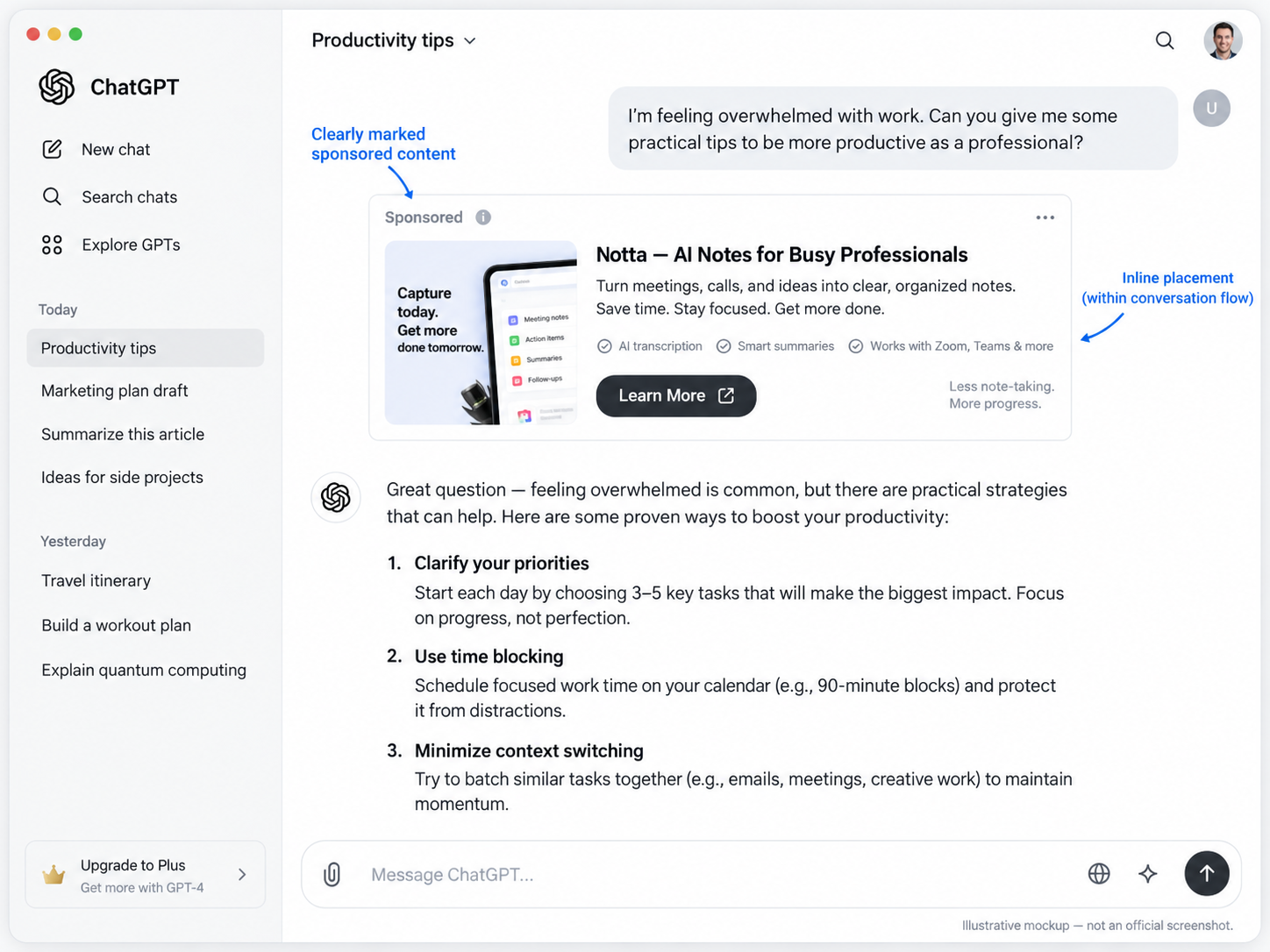
Ads are selected according to expected relevance and outcomes. Signals can include the context and intent of the current conversation, the advertisement’s landing page, headline and copy, and “context hints” supplied by the advertiser. When ad personalization is enabled, selected signals from a user’s broader ChatGPT experience may also be considered.
These context hints can describe conversations, subjects or keywords in which an advertiser’s service may be useful. However, OpenAI emphasizes that they are not conventional exact-match keywords and do not guarantee placement against a particular conversation. OpenAI Help Center: Ads in ChatGPT—The Basics
This means the platform currently resembles a hybrid of paid search and contextual advertising. Advertisers can indicate the situations in which their offering is relevant, but OpenAI’s system ultimately determines whether the ad fits the intent of the conversation.
Where ChatGPT Ads Appear
The principal placement is a sponsored card shown below the end of a ChatGPT response. The ad is separate from the organic answer, allowing a business to appear adjacent to a relevant decision-making conversation without becoming part of ChatGPT’s recommendation.
OpenAI provides several examples of how this may work:
- A conversation about building a backyard fence may be followed by an advertisement for cedar privacy panels.
- Someone researching recipes may see an advertisement for a meal-kit or grocery-delivery service.
- An interior-design conversation may produce an advertisement featuring a relevant home furnishing.
- A user comparing technology products could encounter a relevant product advertisement from a retailer such as Newegg or Best Buy.
The examples are important because they illustrate the platform’s central value proposition: reaching someone not merely because they searched for a keyword, but because the surrounding conversation indicates a potential need. OpenAI Ads, OpenAI: Testing Ads in ChatGPT
Ads are currently limited to eligible users. OpenAI says they are not shown to users on Plus, Pro or Business plans or to accounts identified as belonging to people under 18. Availability also varies by market. OpenAI Help Center: Ads in ChatGPT—The Basics
ChatGPT Ad Formats
The most visible format is currently the image-based sponsored card. It combines a compact visual with an advertiser name, headline, description and destination URL.
OpenAI’s advertising infrastructure also supports product-feed campaigns. Retailers can connect a product catalogue containing titles, descriptions, prices, availability, images and URLs. OpenAI can then select an eligible product when an ad is served rather than requiring the advertiser to create a separate static advertisement for every item. OpenAI Developers: Product Feeds
The available formats can therefore be divided into two practical categories:
1. Chat cards
These are individually created ads containing a headline, body copy, image and destination URL. They are suitable for service businesses, software companies, educational programs, travel providers and other advertisers directing users to a specific landing page.
2. Product-feed ads
These dynamically use information from an advertiser’s product catalogue. They are particularly relevant to ecommerce businesses with frequently changing prices, availability or inventory.
OpenAI has indicated that additional formats, campaign objectives and buying models will be developed as the platform matures. The current format selection should consequently be viewed as the beginning of the product rather than its final state. OpenAI: Testing Ads in ChatGPT
What Does It Cost to Advertise on ChatGPT?
ChatGPT Ads presently supports two principal buying options:
- CPM bidding: Advertisers select a Reach objective, optimize for impressions and pay for every 1,000 impressions.
- CPC bidding: Advertisers select a Clicks objective, optimize for traffic and pay for each valid click.
Advertisers set a maximum CPM or CPC bid at the ad-group level. OpenAI currently recommends beginning CPC campaigns with a maximum bid of approximately US$3–$5 per click. Eligible ads participate in a relevance-weighted, second-price auction. OpenAI Help Center: Ads in ChatGPT—The Basics
OpenAI initially offered CPM buying and added CPC bidding as its self-service Ads Manager expanded. The addition of CPC buying makes the platform considerably more accessible to performance advertisers because it allows spending to be tied to user action rather than exposure alone. OpenAI: New Ways to Buy ChatGPT Ads
Early Campaign Performance: A Look at CPM, CTR and CPC
An early Medical Advertising campaign conducted between August 25 and September 7, 2026 provides a useful—although still very limited—look at real-world costs.
Across three ads, the campaign generated:
| Metric | Early result |
|---|---|
| Impressions | 2,100 |
| Clicks | 17 |
| Spend | CA$66.75 |
| Overall CTR | 0.81% |
| Average CPC | CA$3.93 |
| Effective overall CPM | CA$31.79 |
| Recorded conversions | 5 |
Source: Medical Advertising OpenAI Ads Manager account, August 25–September 7, 2026. Figures calculated from the supplied campaign-level ad data.
The two ads that incurred spend produced quite different results:
| Ad | Impressions | Clicks | CTR | Spend | Avg. CPC | Avg. CPM |
|---|---|---|---|---|---|---|
| ROI | 538 | 4 | 0.74% | CA$27.78 | CA$6.94 | CA$51.63 |
| Lead Generation | 1,533 | 13 | 0.85% | CA$38.97 | CA$3.00 | CA$25.42 |
The most striking result is the CPM. An overall effective CPM of approximately CA$31.79 makes ChatGPT relatively expensive inventory on an impression basis. At that rate, a CA$1,000 budget would purchase only about 31,500 impressions if performance remained consistent.
The creative-level variation is even more important. The ROI ad reached an average CPM of CA$51.63, while the Lead Generation ad delivered at CA$25.42. In practical terms, CA$1,000 spent at those rates would purchase approximately:
- 19,400 impressions at a CA$51.63 CPM
- 39,300 impressions at a CA$25.42 CPM
That is more than a twofold difference in reach.
The Lead Generation advertisement also achieved the stronger click-through rate and a substantially lower cost per click. Its CA$3.00 CPC falls within the US$3–$5 starting-bid range suggested by OpenAI, while the ROI ad’s CA$6.94 CPC was considerably more expensive.
However, the campaign generated no recorded conversions during this period. With only 17 clicks, that is far too little data to conclude that the platform cannot produce leads. It does demonstrate why advertisers should not judge ChatGPT Ads by novelty, impressions or click-through rate alone.
The early takeaway is that ChatGPT inventory may carry a premium, and the financial case will depend heavily on:
- The value of each customer
- The advertiser’s conversion rate
- The strength of the landing page
- The relevance of the conversational context
- The difference in performance between individual creatives
- Accurate conversion tracking
At a CA$3.93 average CPC, a landing page converting 5% of visitors would produce a theoretical cost per lead of approximately CA$78.60. At a 2% conversion rate, that figure would rise to approximately CA$196.50. These are scenarios rather than forecasts, but they show why conversion rate—not CPM by itself—will ultimately determine whether the channel is viable.
Is a High CPM Necessarily a Problem?
Not always.
CPM measures the cost of exposure, but it does not measure the value or intent of the person receiving that exposure. An advertisement appearing beside a detailed conversation about comparing providers, choosing a product or planning a purchase may be more valuable than an impression delivered while someone casually scrolls through a feed.
ChatGPT Ads should therefore be evaluated partly as contextual, decision-stage media. A higher CPM may be justified if the placement consistently reaches users with stronger intent and produces qualified leads or sales.
At the same time, advertisers should not assume that every ChatGPT conversation represents high commercial intent. The platform still needs to prove that its richer contextual signals translate into superior conversion rates. Until an account accumulates enough conversion data, a high CPM should be treated as a cost requiring justification—not as evidence of premium performance.
Measurement and Conversion Tracking
Ads Manager currently reports impressions, clicks, spend, CTR, average CPC, average CPM and conversions. Advertisers can also add UTM parameters to their landing-page URLs so that ChatGPT traffic can be identified in GA4, a CRM or another analytics platform. OpenAI Help Center: Ads in ChatGPT—The Basics
OpenAI provides both a browser-based Measurement Pixel and a server-side Conversions API. OpenAI describes the Conversions API as more reliable than relying on the pixel alone and recommends using it where possible. OpenAI Developers: Conversions API
A serious campaign should ideally include:
- OpenAI’s Measurement Pixel
- Server-side conversion reporting through the Conversions API
- Consistent UTM parameters
- Independent measurement in GA4
- CRM tracking for lead quality and closed revenue
- A shared event ID where browser and server events are both used, preventing duplicate conversions
Without this foundation, advertisers may see clicks in Ads Manager but have no reliable way to determine whether those visitors became qualified leads or customers.
Who Should Test ChatGPT Ads?
The platform may be especially promising for businesses that benefit from research-heavy or comparison-oriented buying journeys, including:
- Software and digital products
- Ecommerce
- Education and professional training
- Home products and local services
- Travel and experiences
- Considered purchases requiring explanation or comparison
Advertisers in regulated categories should confirm eligibility before building a campaign. OpenAI restricts advertising near sensitive, high-stakes or emotionally vulnerable conversations. Healthcare, financial and legal advertisers may require specific approval, and certain claims or categories remain prohibited. OpenAI Ad Policies
For most advertisers, the best starting point is a controlled test with several clearly differentiated messages. The early campaign data above suggests that creative and positioning can have a major effect on CPM and CPC, even within the same account.
ChatGPT Ads and GEO: Two Different Ways to Be Discovered
Advertising is only one way for a company to become visible in an AI-driven customer journey.
Generative Engine Optimization—or GEO—is the process of making a company’s website, expertise, products and supporting evidence easier for AI systems to find, understand and cite. OpenAI states that websites must allow its OAI-Searchbot crawler to access their content to be eligible for inclusion in ChatGPT search results, although visibility is never guaranteed. OpenAI Help Center: ChatGPT Search
The distinction is similar to paid search and SEO:
- ChatGPT Ads provides paid, clearly labelled visibility beneath relevant responses.
- GEO works toward organic visibility when an AI system researches, summarizes or cites useful sources.
- Traditional SEO remains important because search engines, websites and source authority continue to feed the broader information ecosystem.
An AI-forward marketing strategy should include all three. Ads can create immediate visibility in commercially relevant conversations. GEO builds the underlying authority and machine-readable evidence that may help a brand appear organically. Traditional SEO supports discoverability, crawlability and the source material on which both search engines and generative systems rely.
The businesses that benefit most from the transition to AI-assisted discovery will not simply purchase more impressions. They will combine paid access with genuinely useful, authoritative content—earning visibility when the answer is generated and buying visibility when the moment warrants it.